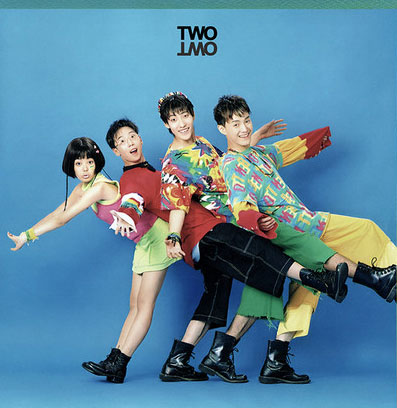
Before Korean pop fully embraced the idol system of the late 1990s, a four-member co-ed group turned a single summer into its own. Two Two (투투) was built by musicians with band roots, yet the public remembers it through a dance step, an outfit, and a face that never smiled.
The group grew out of an underground rock band formed by songwriter and guitarist Oh Ji-hoon, bassist Yoo Hyun-jae, and vocalist Kim Ji-hoon. Hwang Hye-young joined as a guest vocalist shortly before the debut. The original lineup lasted barely a year, but “One and a Half” became one of the defining songs of 1994.
Post Highlights
An Instant Sensation
Two Two reached national stardom within about two months of its debut.
A Song You Could See
The side-stepping choreography and Hwang Hye-young’s doll-like stage persona became as recognizable as the melody itself.
Band Roots Beneath the Dance-Pop
Behind the bright image stood a strong songwriting and vocal foundation: Oh Ji-hoon’s songs and Kim Ji-hoon’s voice.
A Song That Kept Living
“One and a Half” has been referenced by later artists and is still being rediscovered more than thirty years on.
Key Information
| Category | Details |
|---|---|
| Group | Two Two (투투) |
| Original Lineup | Kim Ji-hoon (김지훈, vocals), Oh Ji-hoon (오지훈, leader, guitar, songwriter), Yoo Hyun-jae (유현재, bass), Hwang Hye-young (황혜영, guest vocals) |
| Later Members | Lim Sung-eun (임성은) and Kim Jun (김준) joined as guest vocalists in 1995 |
| Debut Album | Two Two (April 1994) |
| Television Debut | May 1, 1994 |
| Active Period | 1994–1996 (original lineup: 1994) |
| Albums | Two Two (1994), Two Two 2 (1995), New Two Two (1996) |
| Genres | Dance-Pop, Pop-Rock |
| Notable Achievement | “One and a Half” won a Golden Cup on KBS Gayo Top 10 and topped SBS Live TV Gayo 20 |
The Summer of 1994
Two Two - ‘One and a Half’ Live Stage (KBS Gayo Top 10, 1994)
That summer, “One and a Half” was everywhere: on radio, on television music shows, and in shops and streets across South Korea. Its reach went beyond music charts. Hwang Hye-young’s blunt-cut bob wig, neon mini-skirts, and even her bags became fashion trends among young fans.
The People Behind Two Two
Oh Ji-hoon & Yoo Hyun-jae
Friends since middle school, the two had played in bands together for years. Oh led the group and wrote its key songs, including “One and a Half” and “Even Until Your Tears,” while Yoo held down the bass. Their military service ended the original lineup: Yoo enlisted at the end of 1994, and Oh began his service in 1995.
Kim Ji-hoon
The group’s main vocalist, Kim brought a clear, powerful tone that moved easily between dance tracks and ballads. He carried Two Two into its second album, later formed the duo Duke, and passed away in 2013.
Hwang Hye-young
A guest member rather than a founding one, Hwang nonetheless became the group’s public face. Her stage presence was imitated and parodied throughout the mid-1990s, and in 1996 she led the final incarnation of the group, New Two Two.
Essential Listening
1. One and a Half (일과 이분의 일) — 1994
A synth-pop groove, a catchy male-female vocal exchange, and one of the decade’s most recognizable dance moves. GFRIEND’s 2017 track “1/2” paid homage to it, and Koyote quoted its lyrics in “Half” (2022).
2. Even Until Your Tears (그대 눈물까지도) — 1994
Two Two - ‘Even Until Your Tears’ Live Stage (KBS Gayo Top 10, 1994)
A ballad from the debut album and the clearest showcase of Kim Ji-hoon’s voice. It revealed a side of the group that its dance image tended to hide, and it continues to be covered by contemporary vocalists.
3. Cheating Woman (바람난 여자) — 1995
The title track of Two Two 2. With Oh Ji-hoon and Yoo Hyun-jae no longer performing as part of the lineup, Kim Ji-hoon led a reshuffled group alongside Hwang Hye-young, Lim Sung-eun, and Kim Jun.
Why Two Two Still Matters
What makes Two Two particularly interesting is the gap between how the group was built and how it was remembered. Its musical foundations came from musicians with band experience, yet its public identity was shaped just as powerfully by Hwang Hye-young’s expressionless face, colorful outfits, and deceptively simple choreography.
That contrast reveals something important about Korean pop in 1994. A song no longer needed to succeed through melody or vocal performance alone. The way it looked on television could become inseparable from the way audiences remembered it.
Two Two did not invent visual storytelling in Korean pop, nor was it the first group to pair dance music with a designed image. But its brief success showed how effectively those elements could work together, and how completely a sound and an image could fuse into a single moment of popular culture.
Curator’s Note
Two Two’s career was brief, but brevity is not a measure of cultural influence. Some artists build their reputations across decades. Others become inseparable from a single season.
For Two Two, that season was the summer of 1994. The melody, the sideways steps, Hwang Hye-young’s unmistakable expression, and Kim Ji-hoon’s voice became parts of the same cultural memory.
Perhaps that is why “One and a Half” has survived so well. It does not merely remind listeners of a popular song. It brings back the particular energy of Korean pop at a moment when its possibilities seemed to be expanding in every direction.