By 1995, Korean pop was changing almost too quickly to define. Seo Taiji and Boys had broken down the walls between genres, DEUX had pulled hip-hop and new jack swing toward the center of the charts, and dance music was no longer an alternative to ballads but one of the defining sounds of the decade.
Then came R.ef (Rave Effect), three young men who sounded as though a piece of Seoul’s nightclub culture had walked straight onto a television music show. That impression was not an accident. Before they were singers, they were DJs, and their name announced exactly where they came from.
Three DJs and a DJ-Run Company
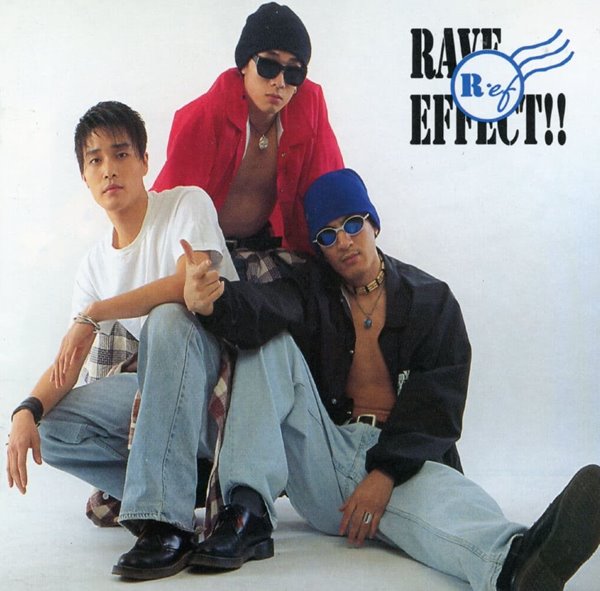
R.ef debuted in 1995 with Lee Sung-wook, Park Cheol-woo, and Sung Dae-hyun. All three had worked as club DJs, and so had the head of their management company, TEAM Planning.
According to later Korean press accounts, the company grew out of a generational shift in the club scene. As new DJs flooded the nightlife industry in the early 1990s, a group of established DJs stepped back from the booth and looked for a new business. Recording was the one they chose, and R.ef was the result.
That background matters. R.ef was not a pop act borrowing a fashionable club sound from the outside. It was club people trying to translate what they knew into a format that could work on national television, at a time when nobody had yet settled what a Korean dance group was supposed to look like.
The Sound: Club Energy, Pop Melodies
🎥 Recommended Watch: R.ef – “Shout in Silence” (고요 속의 외침), 1995
R.ef’s debut album, Rave Effect, was fast, bright, and relentless. Its two signature songs, “Shout in Silence” (고요 속의 외침) and “Farewell Formula” (이별공식), ran on driving electronic rhythms, but their choruses were built to be sung along to in a living room as easily as on a dance floor.
That balance was the real achievement. Pure club music does not need a memorable Korean chorus; a hit on Gayo Top 10 does. R.ef softened the harder edges of dance music with melodies that stuck after a single listen.
It is worth being honest about where that sound came from, though. Despite the “rave” in the name, much of R.ef’s music sat closer to the Eurobeat that was enormously popular in Japan at the time than to the British or European rave scenes. “Shout in Silence,” credited to composer Hong Jae-sun, drew accusations that its chorus stitched together parts of two Japanese Eurobeat tracks, and the album booklet credited Hong alone.
Rather than a footnote, I think that controversy is one of the most revealing things about R.ef. It shows how Korean pop in the mid-1990s was absorbing outside influences quickly, sometimes clumsily, and not always transparently, often by way of Japan rather than directly from the West.
“Farewell Formula”: A Breakup Song That Refuses to Act Like One
🎥 Recommended Watch: R.ef – “Farewell Formula” (이별공식), 1995
If “Shout in Silence” introduced R.ef, “Farewell Formula” made them stars. The song reached No. 1 on KBS’s Gayo Top 10 and remained there for three consecutive weeks in October 1995.
Its appeal lies in a contradiction. The lyrics walk through every cliché of a breakup scene, almost as a checklist: the rain, the sad song in the background, the expected emotional moment. The music, meanwhile, races along brightly, nearly cheerfully. The result is a breakup song that seems to be laughing at the conventions of breakup songs, and that wit is a large part of why it has lasted.
A Short, Enormous Run
The numbers show how big R.ef became, and how quickly. The debut album alone sold about 1.27 million copies, and the second album sold about 1.06 million. Across four studio albums and two additional releases, the group sold roughly 3.7 million records, with its peak concentrated in 1995 and 1996.
The ending was much less glamorous. After a long dispute with their agency, R.ef held their first and only concert on November 8, 1998, and disbanded. Lee Sung-wook and Sung Dae-hyun attempted a two-member return in 2012, without Park Cheol-woo, who had retired, but the comeback faded within the same year.
Watching R.ef Explains More Than Listening Does
R.ef is best revisited through old television performances rather than audio alone. Rapid choreography, constant movement, rap sections, and sung choruses all compete for attention at once.
Modern K-pop has trained us to expect music, choreography, visuals, and member roles to arrive as a finished package. Seen in their own time, R.ef’s stages look less like a blueprint for the idol groups that followed and more like part of the experimentation that came before any blueprint existed.
“Farewell Formula” Outlived Its Moment
In February 2015, twenty years after the original, VIXX released a remake of “Farewell Formula” as the title track of their special single Boys’ Record.
Sung Dae-hyun visited VIXX in the recording studio during the project and praised their version, saying it kept the old nostalgia while fitting contemporary taste.
The remake does not prove that later K-pop descended from R.ef. What it shows is subtler: the song could be separated from the very specific 1995 world that produced it. The styling aged, the clothes aged, the television production certainly aged. The melody did not.
Why R.ef Matters
Told internationally, the history of Korean pop in the 1990s can look surprisingly tidy. Seo Taiji and Boys change everything, first-generation idols appear, the trainee system develops, and K-pop gradually goes global.
The real period was messier, and R.ef belongs to that mess. A company run by former DJs, a sound marketed as rave but rooted in Japanese Eurobeat, a plagiarism controversy, millions of records sold in two years, and a split with their agency within four: none of it fits neatly into a straight line toward modern K-pop.
That is exactly why the group is worth remembering. R.ef captures Korean pop while it was still becoming something new, when musicians, DJs, producers, and companies were absorbing ideas from everywhere and testing what Korean audiences would embrace.
For a few years in the mid-1990s, three former DJs carried the speed of the club onto mainstream television, and Korean audiences bought it by the million.
That is enough of a legacy.