In the spring of 1995, one of the biggest songs in Korea opened with almost nothing at all — a slow groove, a bed of stacked harmonies, and a voice that seemed in no hurry to get anywhere. “Holding the End of This Night” (이 밤의 끝을 잡고) did not try to grab the listener the way the era’s dance hits did, and it did not build toward the dramatic climaxes Korean ballads had trained audiences to expect. It simply settled into its tempo and let Kim Jo-han sing around it. For mainstream Korean pop in the mid-1990s, that restraint was the strange part.
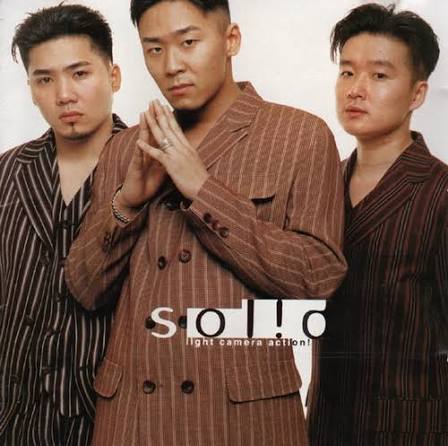
The group behind it, Solid (솔리드), was not new. Jae Chong, Kim Jo-han, and Lee Joon were Korean-American friends from Orange County, California, who had grown up hearing R&B, soul, and hip-hop as the ordinary sound of their surroundings. They recorded demos together, sent them to Korea, and were offered a record deal on the strength of those tapes. By the time “Holding the End of This Night” broke through, they had already spent two years learning how hard it was to make that sound land with Korean listeners.
Solid at a Glance
| Members | Jae Chong (정재윤), Kim Jo-han (김조한), Lee Joon (이준) |
| Debut | 1993, Give Me a Chance |
| Breakthrough | The Magic of 8 Ball (1995) |
| Original run | Four studio albums, 1993–1997, with combined sales widely reported at around 4 million |
| Signature songs | “Holding the End of This Night,” “My Only Friend,” “You Are My First and Last,” “Destiny” |
| Reunion | Into the Light (March 2018), after a 21-year break |
A Debut That Almost Disappeared
Solid’s first album, Give Me a Chance, was released in 1993, with Jang Ho-il of 015B involved as producer. It failed less because of the music than because of what happened around it. Shortly after release, the group’s management company ran into trouble, promotion stalled, and Solid appeared on television only once or twice. Without exposure, record shops had little reason to keep the album on their shelves, and it quietly vanished.
The album is still worth remembering, because it shows what Solid sounded like before they adjusted to the Korean market. It leaned closer to the American pop and R&B the members had grown up with — a sound that was well made but had no obvious place in a chart dominated by ballads and fast-moving dance music.
How The Magic of 8 Ball Changed the Formula
For their second album, Solid made a deliberate shift. Press accounts describe the group stripping back the overtly American pop color of the debut and reshaping their songs around Korean emotional sensibilities.
The result kept the rhythmic language and vocal techniques of R&B but paired them with a melody built for the kind of direct, aching emotion Korean listeners already loved in ballads. The Magic of 8 Ball, released in 1995, became Solid’s first million-seller, and the hip-hop-leaning “My Only Friend” (나만의 친구) followed the title track up the charts. The success was large enough that the label rushed out a reissue of the first album, which suddenly had an audience.
Solid did not invent Korean R&B, and they were not the only musicians experimenting with Black American music in that period. What they accomplished was narrower and, in the long run, more influential: they made an R&B-centered sound feel commercially natural inside Korean mainstream pop rather than a specialty import.
Listening to “Holding the End of This Night”
The easiest way to hear what made the song unusual is to follow the vocal instead of the melody. Kim Jo-han does not approach the song the way many mainstream power ballads of the period were sung, building volume line by line toward a final high note. His notes bend and slide into place, his phrases sit slightly behind or around the beat, and his small runs decorate the line without taking it over. The voice works as part of the groove rather than on top of it.
None of this sounds unusual to a listener in 2026, because the R&B vocal vocabulary he used has since become standard equipment for Korean pop singers. In 1995, it was far less common on mainstream radio, which is exactly why the song has aged into something that feels familiar rather than radical.
Three Members, Three Roles
Much of Solid’s identity came from how clearly the work was divided among the three of them.
Jae Chong — producer and composer. Born in Korea and raised in the United States from age seven, Chong was the group’s musical architect, writing, arranging, and producing much of their catalog. His job was translation: connecting American R&B vocabulary to melodies that could survive in the Korean market.
Kim Jo-han — the voice. Kim’s phrasing, harmonies, and runs gave Solid its sonic signature, and his solo career after the group kept that sound in circulation for decades. His reputation as the “R&B daddy” of Korean music grew out of that long continuity.
Lee Joon — rap, narration, and image. Lee kept Solid from becoming just another vocal group. His low, steady rap and spoken narration gave the songs a counterweight to Kim’s singing, and his stage persona — including the eight-ball cane associated with the second album’s era — gave the group a visual identity as recognizable as its sound.
The Peak Years: Light Camera Action! and After
Solid’s third album, Light Camera Action!, arrived in April 1996 and proved the second album was no accident. Its title track, “You Are My First and Last” (넌 나의 처음이자 마지막이야), added electric guitar to the group’s R&B foundation and topped KBS’s Gayo Top 10 for three consecutive weeks and also reached No. 1 on MBC and SBS music programs. By most accounts, the album became the group’s second straight million-seller.
The album’s real long-term winner, though, turned out to be a follow-up single. “Destiny” (천생연분) gained momentum after the title track’s run and eventually outlasted it, becoming a steady favorite that is still a karaoke standard decades later. “Happy Ending” (해피엔딩) and “Stop Being Angry Now” (이제 그만 화풀어요) also charted, giving the album a run of hits rather than a single moment.
In 1997, Solid released its fourth album, Solidate, and then stepped away while still at the height of its popularity. The members described it as a short break to pursue individual goals. Kim Jo-han continued as a solo R&B artist; Jae Chong worked as a producer between the United States and Taiwan and later developed the group Aziatix and produced the band Royal Pirates; Lee Joon returned to the U.S., completed graduate school, and moved into real-estate work, stepping away from music entirely.
Essential Listening
- “Holding the End of This Night” (이 밤의 끝을 잡고), 1995 — Start here. It captures the exact point where Solid’s R&B vocabulary met the Korean mainstream and won.
- “My Only Friend” (나만의 친구), 1995 — The rhythmic, hip-hop-oriented side of the group, built on the push and pull between Kim’s vocals and Lee’s rap.
- “You Are My First and Last” (넌 나의 처음이자 마지막이야), 1996 — A more polished and harder-edged version of their romantic sound, with guitar added to the mix.
- “Destiny” (천생연분), 1996 — Bright, playful, and instantly singable, it showed that Solid’s identity did not depend on slow tempos. It remains one of Solid’s most recognizable and enduring songs.
- “Into the Light,” 2018 — A retro, 1980s-inspired electronic track that sounds like veteran musicians revisiting their own vocabulary rather than reenacting the 1990s.
Twenty-One Years Later
When the trio reunited, the story they told was disarmingly small. A close friend’s wedding put all three members on stage as groomsmen, guests started recognizing them as Solid, and they ended up singing “Destiny” together. That moment led them back to rehearsing.
Into the Light, released on March 22, 2018, was written, composed, and arranged entirely by the members, with Jae Chong producing. Their May 2018 concerts at Blue Square in Seoul sold out within about five minutes.
By then, the Korean industry they returned to was saturated with the techniques they had once introduced as novelties. R&B phrasing, melismatic runs, and rap breaks were simply part of how K-pop worked. Solid no longer sounded like outsiders bringing a foreign genre into Korea. They sounded like a chapter of the history that had produced everything around them.
Curator’s Note
“Pioneers of Korean R&B” is an accurate label for Solid, but it undersells how specific their achievement was. Their debut never received the exposure it needed to find an audience. Their second album, however, showed how American R&B could connect with Korean listeners on a much larger scale. By keeping the groove and the vocal technique while handing the melody back to Korean emotional instincts, Solid found a form that the mainstream could absorb without resistance.
That is why “Holding the End of This Night” no longer sounds revolutionary. What was new about it in 1995 became so thoroughly absorbed into Korean pop that it now registers simply as how a ballad can sound.