When people think about the early days of K-pop, names like Seo Taiji and Boys and DEUX usually come to mind. Yet another group also played a significant role in shaping Korean dance music during the mid-1990s.
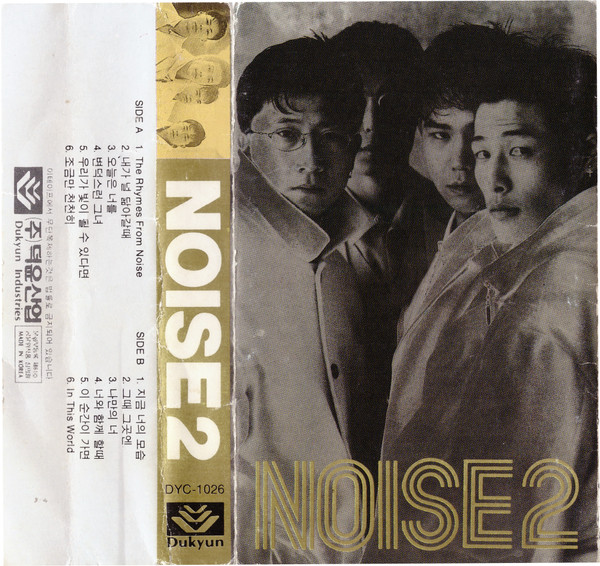
That group was Noise (노이즈).
As Korean pop began embracing electronic dance production, Noise introduced polished, house-inspired dance music that appealed to a wide audience. Their songs were everywhere—on radio, television music shows, highway rest stops, and even the famous unofficial gilboard (“street charts”), best-selling cassette compilations sold by street vendors that often reflected what ordinary people across Korea were actually listening to.
For many Koreans, Noise became the soundtrack to the country’s dance music boom in the early 1990s.
House Music Finds a Korean Voice
Noise debuted in 1993 under producer Kim Chang-hwan, one of the most successful hitmakers in Korean popular music during the 1990s.
Unlike many dance groups of the era, much of Noise’s music was written and composed by member Cheon Seong-il, giving the group a distinctive musical identity.
Rather than simply imitating European house music, Noise blended house-inspired electronic beats with melodic Korean pop songwriting. The result was a sound that felt both contemporary and distinctly Korean.
Bringing House Music into the Mainstream
Noise’s debut single, “What I Wanted From You” (너에게 원한 건), quickly established the group as one of Korea’s leading dance acts.
The song combined bright synthesizers, steady house rhythms, and memorable melodies, making electronic dance music accessible to listeners who had previously been more familiar with ballads and conventional dance pop.
Its success earned Noise five consecutive weeks at No. 1 on KBS’s Gayo Top 10, winning the program’s prestigious Golden Cup, one of Korean television’s highest music honors at the time.
Throughout the mid-1990s, their songs could be heard almost everywhere, from television music programs to neighborhood cassette shops and highway rest stops.
A Remarkable Three-Album Run
🎥 Recommended Watch: NOISE - “You in My Imagination” (1995) [KBS Gayo Top 10]
Rather than becoming a one-hit wonder, Noise continued to evolve over the next several years.
Their second album built on the melodic house sound that had made them popular, while their third album, “You in My Imagination” (상상 속의 너), incorporated stronger techno and Eurodance influences without losing the group’s signature melodic style.
The song became one of the defining Korean dance tracks of 1995 and was later remade by Taiwanese singer Yuki Hsu (徐懷鈺), introducing it to audiences beyond Korea.
Why Noise Mattered
Noise arrived at an important turning point in Korean popular music.
During the early 1990s, digital synthesizers and MIDI-based production were becoming increasingly common, but many listeners still viewed electronic music as unfamiliar or overly mechanical.
Noise helped change that perception.
By combining house-inspired rhythms with warm, melodic songwriting, they showed that electronic dance music could be both approachable and emotionally engaging. Their music brought house-influenced dance pop into the Korean mainstream without losing its local musical identity.
Perhaps their greatest achievement was making electronic dance music feel familiar to ordinary Korean listeners. What had once sounded experimental suddenly became music people could sing, dance, and connect with.
They also demonstrated that polished songwriting, strong production, and memorable melodies could be just as important as choreography in creating successful dance music.
Their Legacy
Although musical trends shifted rapidly with the arrival of first-generation idol groups in the late 1990s, Noise left a lasting mark on Korean pop music.
Their success helped prepare audiences for later electronic dance acts such as Clon and Koyote, while also demonstrating how Western dance music could be adapted into a distinctly Korean style.
Today, many listeners remember Noise for their catchy melodies and nostalgic dance hits.
Their greater contribution, however, was helping establish electronic dance music as a permanent part of Korean popular music.
Long before electronic dance music became a dominant force in global pop, Noise had already shown that house-inspired dance pop could thrive in Korea’s mainstream music industry.
Noise was also among the earliest Korean artists to fully embrace digital music production, helping shape the polished electronic sound that became increasingly common throughout the rest of the decade.