Long before K-pop fans argued over album sales, music-show trophies, and year-end awards, South Korea had already experienced its first great fandom rivalry.
Before H.O.T. and Sechs Kies divided a generation.
Before TVXQ, BIGBANG, EXO, or BTS.
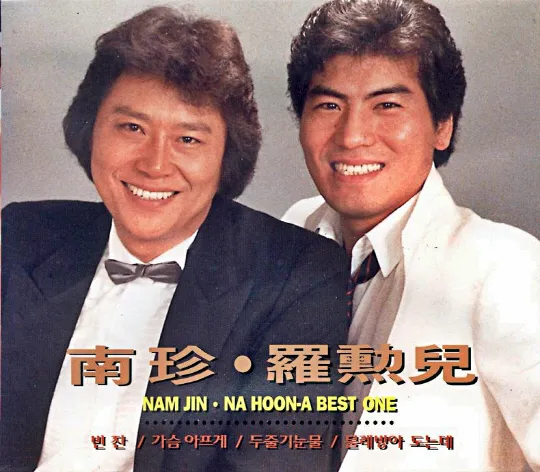
There were Nam Jin and Na Hoon-a.
In the late 1960s and early 1970s, the two singers stood at the center of Korean popular culture. They were not simply successful recording artists. They were national stars whose songs, performances, appearances, and awards were constantly compared.
To support one often seemed to mean opposing the other.
The rivalry spread from concert halls and television studios into newspapers, fan clubs, homes, and everyday conversations. People debated who had the better voice, who drew the larger crowds, and who deserved to be called Korea’s greatest male singer.
The competition became so intense that even an act of violence against one singer was immediately interpreted through the rivalry surrounding them.
That interpretation was not supported by evidence.
But by then, the idea of Nam Jin versus Na Hoon-a had grown larger than either man.
Two Stars Who Seemed Like Opposites
A great rivalry needs contrast, and Nam Jin and Na Hoon-a appeared to offer it in almost every way.
Nam Jin projected a polished, cosmopolitan image. Handsome, stylish, and confident onstage, he had the presence of both a singer and a movie star. His charm was particularly powerful among young women, and he became one of the defining heartthrobs of his era.
Na Hoon-a cultivated a different kind of appeal. His singing was emotionally direct and deeply rooted in Korean popular-song traditions. His resonant voice, distinctive vocal turns, and intense delivery gave his music an earthy quality. He seemed less like a distant celebrity and more like someone capable of expressing the sorrow, longing, and resilience of ordinary people.
These distinctions were never absolute. Nam Jin’s audience was not limited to fashionable young women, and Na Hoon-a’s popularity was not confined to older or working-class listeners. Both men had enormous national followings.
Nevertheless, their contrasting images gave the public an easy story to understand: Nam Jin could be presented as the refined urban star, while Na Hoon-a could be presented as the powerful, rugged voice of the people.
The comparison was irresistible.
Accounts of the era describe the rivalry as unusually broad, extending far beyond the youth-oriented fan bases commonly associated with later idol groups. Students, workers, merchants, farmers, intellectuals, and older listeners all took part in arguments over which singer was superior.
South Korea was not merely watching two stars rise—it was choosing sides.
A Rivalry Bigger Than Music
The two singers competed during a period when Korea’s modern entertainment industry was rapidly expanding.
Television was becoming an increasingly important part of daily life, record production was growing, and large-scale recitals offered singers a way to demonstrate their popularity outside the broadcast studio. Under those conditions, popularity became something that could be measured—or at least presented as measurable.
How many people attended a recital? Which singer received more flowers? Whose fan club was larger? Who won the year-end title?
Rather than treating Nam Jin and Na Hoon-a as two artists with different strengths, the entertainment press repeatedly placed them in direct competition. Concert attendance, record popularity, television exposure, and awards all became evidence in an ongoing national contest.
Their public rivalry was particularly intense around major recitals at Seoul Civic Hall. The language surrounding them often resembled sports coverage: there had to be a winner.
It was a powerful promotional structure. Supporting a favorite singer meant helping him defeat his rival. The entertainment industry and the press both benefited hugely from the excitement.
When the Media Chose Sides
The rivalry was not created entirely by journalists—Nam Jin and Na Hoon-a were genuine competitors at the height of their careers. But the media helped transform professional competition into a much larger cultural conflict.
The rivalry also became entangled with the power of television networks. Viewers and fans sometimes believed that particular networks favored one star over the other. Whether every such claim was accurate mattered less than the perception that the competition extended beyond the singers themselves.
A performance could be interpreted as support, an award as favoritism, and a missing appearance as evidence of disadvantage.
The result was an early version of a pattern that would later become familiar in K-pop: fans did not simply consume music; they watched the institutions around the music.
Korea’s First Fandom War
Modern K-pop fandom is often associated with coordinated streaming, album purchases, fan voting, and social-media campaigns. The technology was different in the early 1970s, but the underlying emotions were already visible.
Fans gathered at performances and broadcasting stations. They competed through attendance, public displays of support, flowers, gifts, and enthusiastic cheering. The opposing fandom became part of the experience.
Supporters argued over popularity and talent. Encounters around venues could become heated, and confrontations between rival supporters were not uncommon.
The Nam Jin–Na Hoon-a rivalry established a pattern that would return throughout Korean pop history: the artists were competitors, the fans turned competition into identity, and the media turned identity into spectacle.
Were Nam Jin and Na Hoon-a Really Enemies?
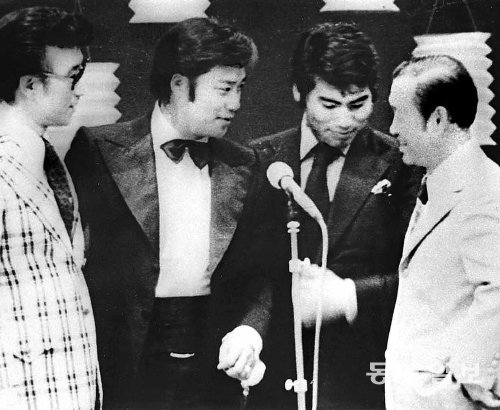
Source: The Dong-A Ilbo
The public story suggested two men locked in bitter personal conflict, but reality was more complicated.
Nam Jin and Na Hoon-a undoubtedly competed for the same audience, awards, and broadcast opportunities, but competition is not the same as hatred.
Over the years, the two men appeared together and spoke about the rivalry with greater distance. They understood that the comparison helped shape both of their careers. To stand beside the only singer considered your equal created legend.
However, no matter what they said or did, the audience continued to interpret their careers as a duel. Then, on June 4, 1972, that narrative took a violent turn.
The Night of the Attack
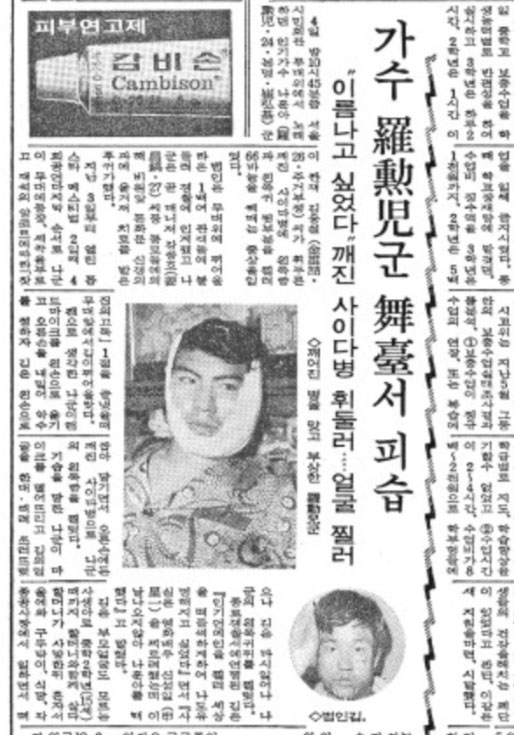
Source: The Chosun Ilbo
Na Hoon-a was performing at Seoul Civic Hall during a show commonly identified as Show Star Festival.
It was late in the evening. While singing an encore, a man in his twenties suddenly rushed onto the stage wielding a broken glass bottle.
Na Hoon-a was slashed across the left side of his face, suffering a severe wound that required 72 stitches. The scar remained visible throughout his life and became part of his iconic image.
The assault shocked the country. The attacker was arrested, but the rivalry surrounding Na Hoon-a created the conditions for another rumor to emerge: Nam Jin’s name entered the investigation.
When Rumor Moved Faster Than Evidence
Because Nam Jin was publicly portrayed as Na Hoon-a’s greatest rival, the public was already prepared to interpret almost anything through their competition.
The attacker made statements attempting to connect himself to Nam Jin, leading to Nam Jin being questioned by prosecutors. However, investigators found no evidence that Nam Jin had ordered, supported, or participated in the assault. The attacker also had a history of threatening celebrities for money.
Nam Jin was not the mastermind behind the attack—he was another victim of the narrative.
The rumor spread because years of headlines, comparisons, and winner-versus-loser narratives had created an atmosphere in which an extraordinary accusation could travel faster than the facts.
The Darkest Moment of the Rivalry
The assault is often remembered as the most shocking episode in the history of their competition, but the existing rivalry shaped the public reaction. Without years of exaggerated competition, the attacker’s statements might have been recognized more quickly as unverified claims.
Instead, the rumor became an extension of the entertainment narrative, crossing the line from publicity into dangerous suspicion.
What the First Fandom War Left Behind
Nam Jin and Na Hoon-a continued to become two of the most important singers in Korean popular-music history.
Nam Jin remained a defining entertainer known for his voice, visual charisma, and stage presence. Na Hoon-a built an extraordinary career through his singing, songwriting, and emotional intensity.
Yet their names are still spoken together. Their rivalry demonstrated how effectively the entertainment industry could build excitement through opposition, but it also exposed the risks when loyalty turns into hostility and facts lose their importance.
Before K-pop Had a Name
Though they emerged long before today’s trainee system, global platforms, or social media, the culture surrounding Nam Jin and Na Hoon-a contained many recognizable elements of modern fandom: superstar images, organized supporters, public displays of loyalty, and media-driven narratives.
The first great fandom war in Korean popular music was not born on the internet—it began in packed concert halls, television studios, and newspaper columns.
The 1972 attack left Na Hoon-a with a permanent scar, left another kind of scar on the history of Korean music, and left behind a powerful, passionate, and sometimes dangerously divisive model of fandom.