Curator’s Note
This article is not K-pop history in the strict sense. Rather, it documents one of the defining youth culture phenomena that shaped the cultural landscape immediately before the emergence of modern K-pop. Understanding the New Kids on the Block phenomenon helps explain the cultural environment in which Korea’s modern idol industry would soon emerge.
A Nation on the Verge of Cultural Change
In early 1992, South Korea stood at a cultural crossroads.
The country had entered a new era of rapid globalization following the 1988 Seoul Olympics, yet mainstream society remained deeply conservative. Young people were expected to prioritize education, respect authority, and avoid overt displays of celebrity fandom—a sharp contrast to the fan culture that would soon define modern K-pop.
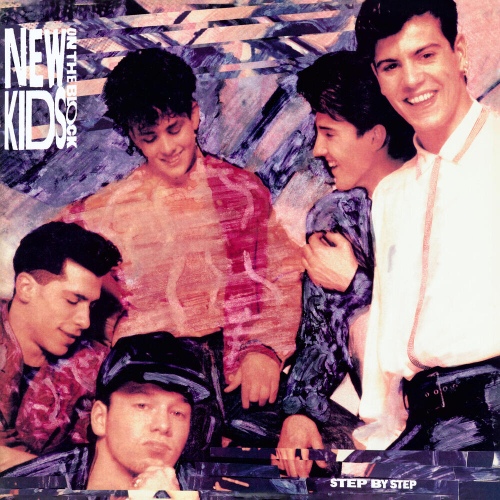
Against this backdrop, New Kids on the Block (NKOTB) became far more than a successful American pop group. For many Korean teenagers, they represented a new form of global youth culture centered on fandom, identity, and emotional connection with popular artists.
When the group’s Seoul concert was announced, anticipation reached unprecedented levels.
What followed on 17 February 1992 would become one of the most significant incidents in the history of live popular music in South Korea.
The Arrival of a New Youth Phenomenon
Years before H.O.T., Sechs Kies, or BTS, Korean teenagers were already experiencing organized fan culture through international pop stars.
By the early 1990s, songs such as “Step by Step” and “You Got It (The Right Stuff)” had become enormously popular among Korean youth. Fans collected imported magazines, exchanged cassette tapes, and eagerly followed every piece of news about the group.
To many teenagers, NKOTB represented freedom, individuality, and participation in an emerging global youth culture.
To many adults, however, the phenomenon appeared unfamiliar and unsettling. Contemporary news coverage often portrayed the intense enthusiasm surrounding the group as excessive or socially undesirable, reflecting broader generational tensions over changing cultural values.
17 February 1992: A Concert Turns Into Disaster
The concert took place at Seoul’s Olympic Gymnastics Arena before a crowd of approximately 15,000–16,000 people. As the performance began, large numbers of excited fans surged toward the stage, causing people near the front to fall and become trapped beneath the pressure of the crowd.
The performance was halted as emergency responders attempted to reach the injured.
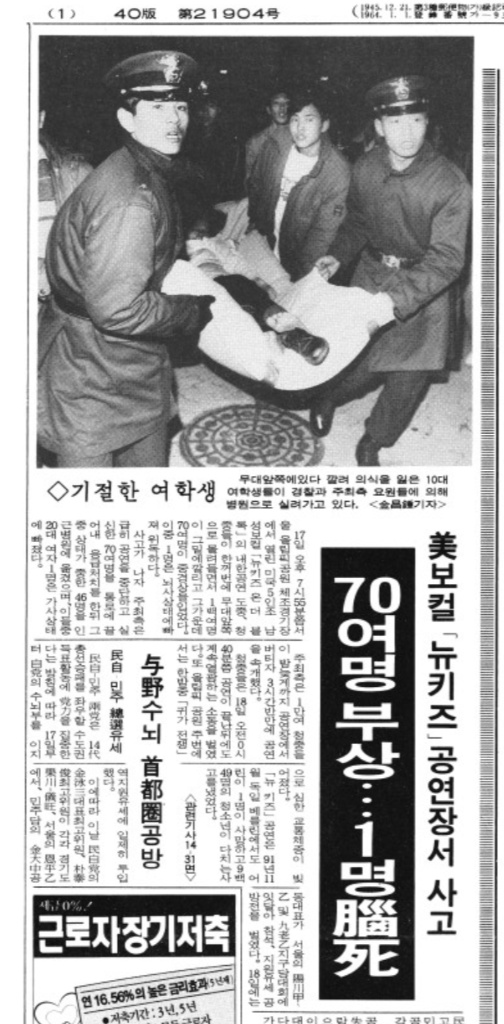
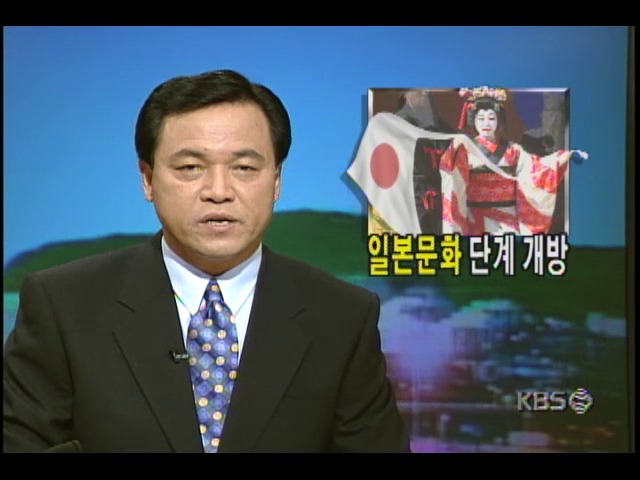
| Source: KBS News 9 (Feb 18, 1992) | “NKOTB Concert Tragedy” |
The tragedy ultimately claimed the life of an 18-year-old high school student, while dozens of others were injured or hospitalized. Contemporary reports described scenes of confusion as medical teams struggled to assist victims inside the densely packed venue.
Subsequent investigations identified multiple contributing factors, including inadequate crowd management, insufficient safety preparations, and the admission of more spectators than originally authorized. The concert promoter was later arrested on charges related to professional negligence and violations of the Performance Act.
Public Reaction
The tragedy dominated national headlines.
Many newspapers and television broadcasts initially criticized the behavior of teenage fans, portraying the incident as evidence of excessive celebrity obsession. As investigations progressed, however, public attention increasingly shifted toward questions of venue management, event planning, and organizer responsibility.
The incident exposed how unprepared South Korea’s live-event industry was for the scale and intensity of modern pop fandom.
Why the Incident Matters in K-pop History
Just two months later, Seo Taiji and Boys made their historic debut, ushering in a new era of Korean popular music.
The New Kids on the Block tragedy did not create the K-pop industry, nor did it single-handedly transform Korea’s concert safety system. It did, however, expose critical weaknesses in crowd management and became one of several incidents that prompted greater attention to safety planning for large-scale live events.
As Korea’s idol industry expanded throughout the 1990s and 2000s, concert organizers increasingly adopted more systematic approaches to venue operations, crowd management, emergency planning, and audience safety.
Legacy
Today, the 1992 New Kids on the Block concert tragedy is remembered not because it involved an American pop group, but because it revealed the challenges of a rapidly changing youth culture in South Korea.
The incident reminds us that the rise of modern fan culture brought not only new forms of enthusiasm and participation, but also new responsibilities for organizers, venues, and public authorities.
For students of K-pop history, it stands as an essential chapter in the evolution of Korea’s live music culture. Although it predates modern K-pop, it helps explain how the industry gradually came to recognize that successful concerts depend not only on unforgettable performances, but also on careful planning, responsible crowd management, and an unwavering commitment to audience safety.