oday, K-pop idols regularly perform sold-out Tokyo Dome concerts, collaborate with Japanese producers, and top the Oricon charts with original Japanese releases.
Yet for more than five decades, Japanese music, films, television broadcasts, and theatrical anime were subject to extensive legal and regulatory restrictions in South Korea.
The story of South Korea’s long-standing ban on Japanese popular culture—and its gradual lifting between 1998 and 2004—is one of the most intriguing chapters in modern East Asian cultural history. Ironically, the decades-long restriction became one of the unexpected forces that shaped the modern K-pop industry.
Post Highlights
A Decades-Long Cultural Embargo
From 1945 until 1998, South Korea maintained extensive restrictions on Japanese media to protect domestic culture and address complex post-colonial sensitivities.
The Underground Influence
Despite official restrictions, Japanese music never completely disappeared, entering the country through travelers, sailors, and university campuses.
A Catalyst for Innovation
Phasing out the ban motivated Korean music agencies to modernize their training, management, and production standards, turning anticipated competition into global ambition.
Key Information
| Category | Details |
|---|---|
| Topic | Ban on Japanese Popular Culture (일본 대중문화 개방/금지) |
| Ban Period | 1945 – October 1998 (Phased out until January 2004) |
| Restricted Media | Japanese music (CDs/cassettes), movies, TV broadcasts, anime, and comics |
| Key Milestone | President Kim Dae-jung’s 1998 declaration of cultural opening |
| Historical Impact | Drove Korean entertainment agencies to globalize and elevate production standards |
Why Was Japanese Culture Banned?
Following the end of Japanese colonial rule in 1945, South Korea faced the urgent task of rebuilding its national identity and preserving its domestic artistic traditions.
The policy was shaped by both historical memory and nation-building efforts during the country’s formative post-war decades. To prevent cultural dominance and address deep-rooted historical grievances, successive South Korean governments largely prohibited the commercial import, public performance, and broadcast of Japanese media.
For decades, hearing Japanese lyrics on Korean television or radio was restricted. Japanese films could not be screened in public theaters, and Japanese comic books (manga) had to be heavily localized or edited to obscure their origins before publication.
Music in the Shadows: Bootlegs & Campus Culture
Despite official restrictions, Japanese music never completely disappeared.
Bootleg cassette tapes and CDs entered Korea through travelers, sailors, and port cities such as Busan, while students quietly exchanged copied albums on university campuses in Seoul. For many aspiring Korean musicians and producers, J-pop and Japanese rock became something to secretly discover rather than something easily purchased.
Many musicians and producers were exposed to Japanese pop, city pop, rock, and fusion music, whose sophisticated production techniques subtly influenced certain trends in Korean popular music during the late 1980s and 1990s.
Unexpected Cultural Exchanges & Legal Remakes
| 🎥 Shohjo-tai (少女隊) – “Tell Her” (Cover of Sobangcha) | MBC Saturday Saturday is Fun (Feb 1988) |
A historic performance broadcast live on Korean TV a decade before the official lifting of the ban.
Historical Note
This historic performance by the Japanese idol group Shohjo-tai (少女隊) took place in February 1988, a decade before South Korea officially lifted its ban on Japanese popular culture in 1998. Granted a rare exception ahead of the 1988 Seoul Olympics, Shohjo-tai became one of the very first Japanese pop acts to perform live on Korean national television (MBC), singing a cover of Sobangcha’s hit “Tell Her.”
While direct Japanese imports were forbidden, a surprising number of iconic Japanese melodies legally entered the Korean market through authorized remakes—frequently featured in film soundtracks or re-recorded by top Korean vocalists.
- Ra Jong-min – “Say Yes” (1993): A direct Korean adaptation of CHAGE and ASKA’s historic 1991 J-pop hit “SAY YES”, featured as the main theme for the Korean film The 101st Proposal.
- Anzen Chitai & Koji Tamaki: The legendary Japanese band Anzen Chitai (and lead singer Koji Tamaki) developed a devoted underground following in Korea. Many Korean listeners first encountered his music through officially licensed Korean remakes rather than the original Japanese recordings.
Did the Ban Work?
In the short term, the restrictions limited the official distribution of Japanese media in South Korea. However, they did not eliminate public curiosity.
Through bootleg recordings, overseas travel, and unofficial exchanges, many Korean musicians and fans continued to encounter Japanese popular culture. By the late 1990s, the gradual opening acknowledged a reality that cultural exchange had already begun while preparing Korean industries to compete internationally.
The Four-Stage Cultural Opening (1998–2004)
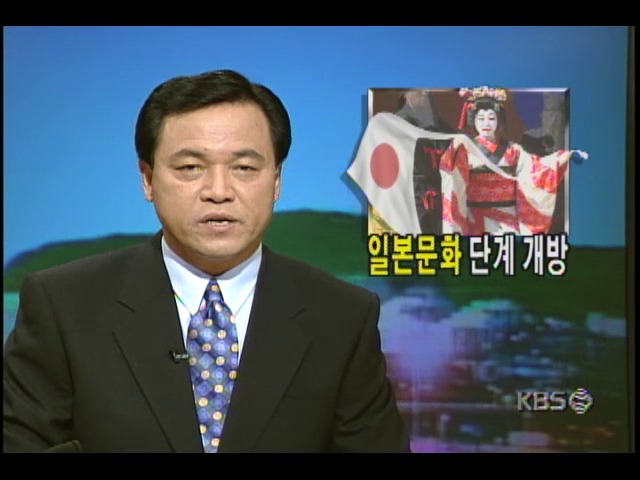
| 🎥 The First Phase of Lifting the Ban on Japanese Culture (Oct 20, 1998) | KBS News Broadcast |
Historic news report from October 1998 covering South Korea’s official announcement to open its doors to Japanese popular culture.
In October 1998, President Kim Dae-jung made the historic policy decision to phase out the ban, declaring confidence in the strength and creativity of Korean culture.
To prevent sudden market disruption, the Korean government implemented a gradual, four-stage roadmap:
- Stage 1 (October 1998): Allowed award-winning Japanese art films and international co-productions.
- Stage 2 (September 1999): Opened theaters to general Japanese movies and permitted live music concerts in smaller venues (under 2,000 capacity).
- Stage 3 (June 2000): Allowed theatrical animation, larger concert venues, and physical album sales (excluding TV broadcast play).
- Stage 4 (January 2004): Fully lifted restrictions on Japanese movies, music sales, and home video, gradually easing terrestrial TV broadcasting rules.
How Lifting the Ban Supercharged K-Pop
When the opening was first announced in 1998, domestic critics voiced intense concern that Japanese entertainment powerhouses would quickly dominate the South Korean market.
Instead, the looming competition acted as a powerful catalyst for growth. Pioneering agencies such as SM Entertainment closely studied Japan’s entertainment industry. Japan already possessed Asia’s largest music market, sophisticated idol management systems, and a mature concert industry. Korean agencies recognized that succeeding there required higher production standards than ever before.
Korean entertainment companies proactively overhauled their business models—adopting disciplined in-house trainee systems, state-of-the-art sound engineering, and systematic international marketing strategies. Rather than competing defensively at home, they launched local strategies abroad, sending young talents to conquer foreign charts from within.
Curator’s Note
Today, the relationship has come full circle.
Korean artists now top Japan’s Oricon charts, sell out Tokyo Dome concerts, and collaborate with Japanese musicians—an unimaginable reality during the decades when Japanese popular culture was subject to extensive legal restrictions in South Korea.
Understanding this era reveals that K-pop’s explosive growth was neither accidental nor overnight. It was forged through decades of cultural isolation, quiet creative adaptation, and a bold decision in 1998 that turned anticipated foreign competition into a catalyst for innovation and global ambition.