When Yoon Sang (윤상) released his first solo album in 1990, Korean pop was already changing rapidly.
But his music sounded distinctly different.
Instead of building songs around dramatic vocal climaxes, Yoon Sang placed unusual emphasis on arrangement, harmony, rhythm, and electronic texture. Synthesizers were not simply decorative additions to his songs—they were fundamental to the way his music was constructed.
The result was a restrained, meticulously produced form of pop that became immediately recognizable as his own.
Before Yoon Sang became known as a composer and producer for other artists, his solo recordings had already established one of the most distinctive sounds in early-1990s Korean popular music.
Post Highlights
From Composer to Solo Artist
Yoon Sang began working professionally as a composer in the late 1980s before releasing his first solo album in 1990.
A Distinctive Electronic Sound
Synthesizers, programmed rhythms, sophisticated harmonies, and carefully layered arrangements became central elements of his music.
Songs Built Through Collaboration
While Yoon Sang composed much of his signature repertoire, important lyricists—including Park Joo-yeon and Park Chang-hak—helped shape the songs that defined his career.
A Musical Identity That Endured
From “The Shadow of Farewell” to “Between Hidden Times” and later “Running,” his compositions continued to find new listeners through recordings, remakes, and reinterpretations.
Key Information
| Category | Details |
|---|---|
| Korean Name | 윤상 (Yoon Sang) |
| Composer Debut | 1987 |
| First Solo Album | 1990 |
| Occupation | Singer · Composer · Producer · Arranger |
| Musical Style | Pop · Ballad · Electronic Pop · Synth-pop |
| Known For | Sophisticated composition, electronic arrangements, and restrained emotional expression |
Before He Became a Singer
Yoon Sang’s career did not begin behind a microphone.
He first entered the Korean music industry as a composer in the late 1980s. Before releasing music under his own name, he was already writing songs for other singers.
One of his important early successes was “In Your Memories” (추억 속의 그대), recorded by Hwang Chi-hoon in 1988. He later composed songs that became major hits around the turn of the decade, including Kim Min-woo’s “In the Enlistment Train” (입영열차 안에서) and Kang Susie’s “Violet Fragrance” (보랏빛 향기).
By the time Yoon Sang released his own album, he was therefore not an unknown newcomer but a composer who had already demonstrated an instinct for memorable pop songwriting.
His transition from composer to recording artist gave him something else: a space in which he could develop a musical identity entirely around his own sensibilities.
The First Album
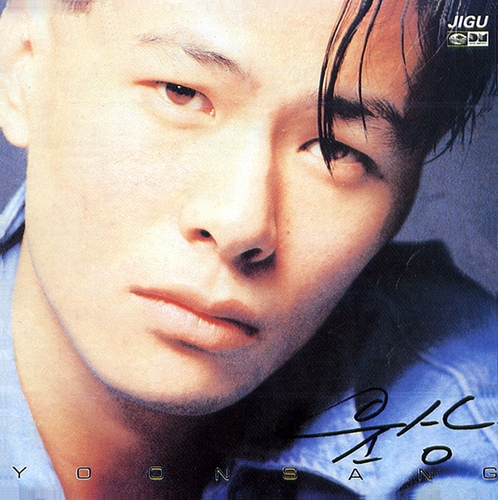
Yoon Sang’s self-titled debut album was released on November 30, 1990.
Its opening track, “The Shadow of Farewell” (이별의 그늘), became one of the songs most closely associated with him.
Written by lyricist Park Joo-yeon (박주연) and composed by Yoon Sang, the song offered an early demonstration of what would become characteristic of his music: melancholy without excessive drama, a carefully controlled vocal performance, and an arrangement in which electronic sound played a central role.
Another standout was “One More Step” (한 걸음 더), with lyrics by Park Chang-hak (박창학) and music by Yoon Sang.
Brighter and more rhythmic than “The Shadow of Farewell,” the song showed another side of his musical vocabulary, combining an accessible pop melody with electronic instrumentation and jazz-pop elements.
Together, the songs established a musical identity that was difficult to confuse with anyone else’s.
Why Yoon Sang Sounded Different
What distinguished Yoon Sang was not simply his use of synthesizers. Electronic instruments had already entered Korean popular music before his debut.
What mattered was how central they became to his musical language.
Electronic Sound as Structure
Synthesizers and programmed sounds were often fundamental components of his arrangements rather than effects added to otherwise conventional ballads.
“The Shadow of Farewell,” for example, demonstrates how electronic textures could carry much of a song’s atmosphere while leaving its melody emotionally direct.
Harmony and Arrangement
Yoon Sang’s compositions frequently placed unusual emphasis on chord movement, instrumental detail, and carefully controlled changes in texture.
The arrangement itself became part of the storytelling.
Emotional Restraint
His singing was equally distinctive.
Yoon Sang was not a powerhouse vocalist in the conventional ballad tradition, nor did his songs require him to be one. His relatively restrained delivery suited compositions in which emotion emerged gradually through melody, lyrics, harmony, and atmosphere.
That relationship between voice and production became one of the defining characteristics of his recordings.
“Between Hidden Times”
Yoon Sang expanded this musical language further with his second album.
Released in 1992, “Between Hidden Times” (가려진 시간 사이로) became another of his signature recordings.
The song combined an atmospheric arrangement with a melody centered on memory and emotional distance. Rather than relying on a dramatic climax, it develops its mood through repetition, harmony, and carefully controlled production.
It remains one of the clearest examples of the musical aesthetic Yoon Sang had been developing since his debut.
Songs That Defined His Early Career
The Shadow of Farewell (이별의 그늘)
The opening track of his 1990 debut album and one of the essential starting points for understanding Yoon Sang’s early sound.
One More Step (한 걸음 더)
A brighter counterpart to his more melancholic material, combining Park Chang-hak’s lyrics with Yoon Sang’s melodic and rhythmic pop writing.
Between Hidden Times (가려진 시간 사이로)
Released in 1992, the song further developed the atmospheric and harmonically detailed style associated with Yoon Sang’s early recordings.
Always (언제나 그랬듯이)
A recording that highlights the quieter, intimate side of his songwriting and production.
Rehearsal (리허설)
Part of his continuing exploration of carefully constructed pop in the mid-1990s.
No Dance and “Running”
In 1996, Yoon Sang joined Shin Hae-chul (신해철) to form the electronic project duo No Dance (노땐스).
The collaboration brought together two musicians who had each been exploring electronic sound from very different directions.
Their album Golden Hit included “Running” (달리기), composed by Yoon Sang with lyrics by his longtime collaborator Park Chang-hak.
The song would eventually develop a cultural life far beyond the original project.
A later version by S.E.S. introduced it to another generation, while subsequent interpretations—including one by indie duo Rooftop Moonlight (옥상달빛)—continued to bring the composition to new listeners.
Its lyrics about exhaustion, persistence, and continuing forward helped turn “Running” into one of Yoon Sang and Park Chang-hak’s most enduring collaborations.
Recommended Performances
🎥 Yoon Sang Stage Compilation KBS Broadcast Archives
A collection of television performances offering a glimpse of how Yoon Sang presented his carefully produced studio music on Korean broadcast stages.
More Than a Singer
Calling Yoon Sang simply a singer-songwriter does not fully explain his role in his own music.
Composition and arrangement were central to his artistic identity, and his recordings reveal the sensibility of a musician interested in how every part of a song fits together—from melody and harmony to synthesizer texture and rhythm.
At the same time, his work was often collaborative.
Lyricists such as Park Joo-yeon and particularly Park Chang-hak played important roles in giving words to the musical worlds Yoon Sang created. That combination of a strong individual sonic identity and sustained collaboration became an important feature of his career.
Essential Listening
| Song | Why It Matters |
|---|---|
| The Shadow of Farewell (이별의 그늘) | An essential introduction to the electronic textures and restrained emotion of Yoon Sang’s debut period. |
| One More Step (한 걸음 더) | Shows the brighter and more rhythmic side of his early pop writing. |
| Between Hidden Times (가려진 시간 사이로) | One of the clearest expressions of his atmospheric early-1990s style. |
| Always (언제나 그랬듯이) | Highlights the understated emotional character associated with his recordings. |
| Running (달리기) | A Yoon Sang–Park Chang-hak composition whose later covers introduced it to successive generations. |
Curator’s Note
The most revealing way to understand Yoon Sang’s early music may be to listen beyond the vocal.
Listen to what happens underneath it.
The synthesizer tones, bass lines, chord changes, programmed rhythms, and spaces between sounds are rarely incidental. They are part of the composition itself.
That attention to sound is what connects the different phases of Yoon Sang’s career. He began as a composer, became a successful recording artist, and continued developing as an arranger and producer—but the underlying fascination with how a song is constructed remained remarkably consistent.
For contemporary K-pop listeners, there is also an unexpected generational connection: Yoon Sang is the father of Anton (앤톤) of RIIZE. But that family connection is only a footnote to a musical career that had already been unfolding for decades.
And Yoon Sang’s influence did not stop with his own recordings.
In Part 2, we turn to the other side of his career: Yoon Sang the composer and producer, and the songs he created for other artists.