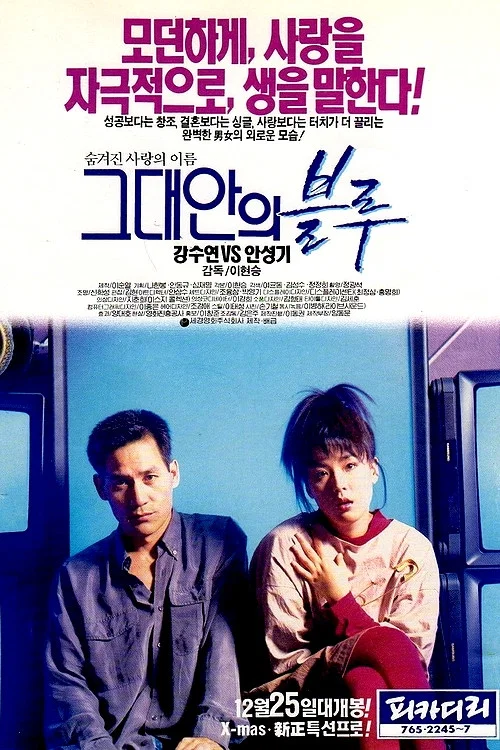
Few Korean films are remembered as closely for their soundtrack as The Blue in You (그대 안의 블루).
Released on December 25, 1992, the film introduced audiences to a sophisticated urban romance at a time when Korean cinema was beginning to embrace more visually expressive storytelling. Directed by Lee Hyun-seung (이현승) and featuring music by Kim Hyun-chul (김현철), The Blue in You blended elegant cinematography, contemporary design, and mature emotional themes into one of the most distinctive Korean films of the early 1990s.
While the film earned praise for its artistic style and performances, its greatest legacy became its unforgettable title song, “The Blue in You”, performed by Kim Hyun-chul and Lee Sora (이소라). More than three decades later, the song remains one of the most beloved duets in Korean popular music.
Post Highlights
A Landmark Korean Romance
A visually sophisticated romance that reflected the changing aspirations of urban Korea in the early 1990s.
The Song That Outlived the Film
The title track became one of Korea’s greatest duet songs and eventually surpassed the film itself in public recognition.
Lee Sora’s Official Debut
The soundtrack introduced Lee Sora to the Korean public, launching one of the country’s most respected vocal careers.
Key Information
| Category | Details |
|---|---|
| Film | The Blue in You (그대 안의 블루) |
| Release Date | December 25, 1992 |
| Director | Lee Hyun-seung (이현승) |
| Screenplay | Lee Hyun-seung (이현승) |
| Adaptation | Yeo Kyun-dong (여균동), Kim Sung-su (김성수) |
| Starring | Ahn Sung-ki (안성기), Kang Soo-yeon (강수연), Kim Hyung-il (김형일) |
| Music | Kim Hyun-chul (김현철) |
| Genre | Romance · Drama |
| Running Time | 115 minutes |
Plot
The film follows Ho-seok (Ahn Sung-ki), a talented display designer, and Yoo-rim (Kang Soo-yeon), a married woman striving to build a meaningful career while feeling increasingly confined by traditional expectations of marriage.
Working together on design projects, the two gradually develop mutual respect and an emotional connection. Yet rather than ending with a conventional romantic resolution, the story takes a different path.
Faced with a choice between love and personal fulfillment, Yoo-rim ultimately decides to define her future on her own terms. Rejecting both the security of an unhappy marriage and the possibility of simply becoming Ho-seok’s partner, she leaves for Italy alone to pursue advanced studies in design.
At the time of its release, this ending was considered remarkably progressive, portraying a woman whose greatest achievement was self-realization rather than romance.
A New Visual Language for Korean Cinema
Directed by Lee Hyun-seung, The Blue in You represented a new generation of Korean filmmaking that emphasized atmosphere over melodrama.
The film became known for its carefully composed imagery, modern production design, and restrained use of color—particularly its elegant blue palette and monochromatic aesthetics. Rather than relying on dramatic dialogue, it conveyed emotion through visual composition, architecture, fashion, and music.
These stylistic choices perfectly complemented Kim Hyun-chul’s sophisticated soundtrack, creating a rare harmony between image and sound.
The OST That Outlived the Film
🎥 “The Blue in You” (Movie The Blue in You OST), 1992
Although The Blue in You was well received, its soundtrack ultimately achieved even greater cultural longevity.
Composed and produced by Kim Hyun-chul, the title song paired his sophisticated blend of jazz-pop, adult contemporary, and soft pop with the then-unknown vocalist Lee Sora.
Unlike the dramatic power ballads that dominated Korean music at the time, “The Blue in You” embraced subtle emotion, elegant harmonies, and conversational vocals. Its understated beauty made it one of the defining Korean pop recordings of the early 1990s.
Today, the song continues to be covered by younger artists and is widely regarded as one of Korea’s greatest duet recordings.
The Song That Introduced Lee Sora
| 🎥 Lee Sora, Kim Hyun-chul - “The Blue in You” | KBS Lee Sora’s Propose (Broadcasted Nov 2, 1996) |
Beyond becoming a timeless classic, “The Blue in You” also marked the official debut of Lee Sora.
At the time, she was virtually unknown to the general public. Kim Hyun-chul selected her distinctive voice for the duet, recognizing that her restrained yet expressive singing perfectly matched the song’s emotional atmosphere.
The recording immediately introduced Lee Sora to a nationwide audience and launched one of Korea’s most respected vocal careers. She later gained additional recognition as a member of Strangers (낯선 사람들) before establishing herself as one of Korea’s defining solo artists.
Essential Tracks
| Song | Artist | Why It Matters |
|---|---|---|
| The Blue in You (그대 안의 블루) | Kim Hyun-chul & Lee Sora | One of Korea’s greatest duet songs and Lee Sora’s official debut recording. |
| In Dongsung-ro (동숭로에서) | Kim Hyun-chul | Captures the sophisticated urban atmosphere of early-1990s Seoul through jazz-influenced pop. |
| On a Pure White Night (새하얀 밤에) | Kim Hyun-chul | A refined soul-pop ballad showcasing Kim Hyun-chul’s signature musical style. |
| The Blue in You (Instrumental) | Kim Hyun-chul | Highlights the film’s elegant atmosphere and cinematic orchestration. |
Why the OST Matters
The soundtrack to The Blue in You demonstrated that a Korean film soundtrack could transcend the screen and become a lasting pop standard.
It introduced a sophisticated urban sound that blended jazz, pop, and adult contemporary influences while helping establish Lee Sora as one of Korea’s finest vocalists. More broadly, it strengthened the growing relationship between Korean cinema and popular music—a connection that would become one of the defining characteristics of Korean entertainment in the decades that followed.
Legacy
Today, The Blue in You is remembered as both an accomplished romance film and one of the most important soundtrack albums in Korean popular music.
While the film remains admired for its visual artistry and mature storytelling, its title song has achieved an even greater legacy. More than thirty years after its release, “The Blue in You” continues to resonate with listeners, standing as a timeless duet and a landmark in the careers of both Kim Hyun-chul and Lee Sora.
Curator’s Note
Some films are remembered for their stories. Others are remembered for their music.
The Blue in You belongs to the rare second category. The film captured the changing values of early-1990s Korea through its modern visual style and progressive heroine, while its soundtrack transcended the screen to become part of the nation’s musical memory.
More than thirty years later, The Blue in You remains a remarkable example of how cinema and popular music can elevate one another, creating a cultural legacy that endures long after the credits roll.