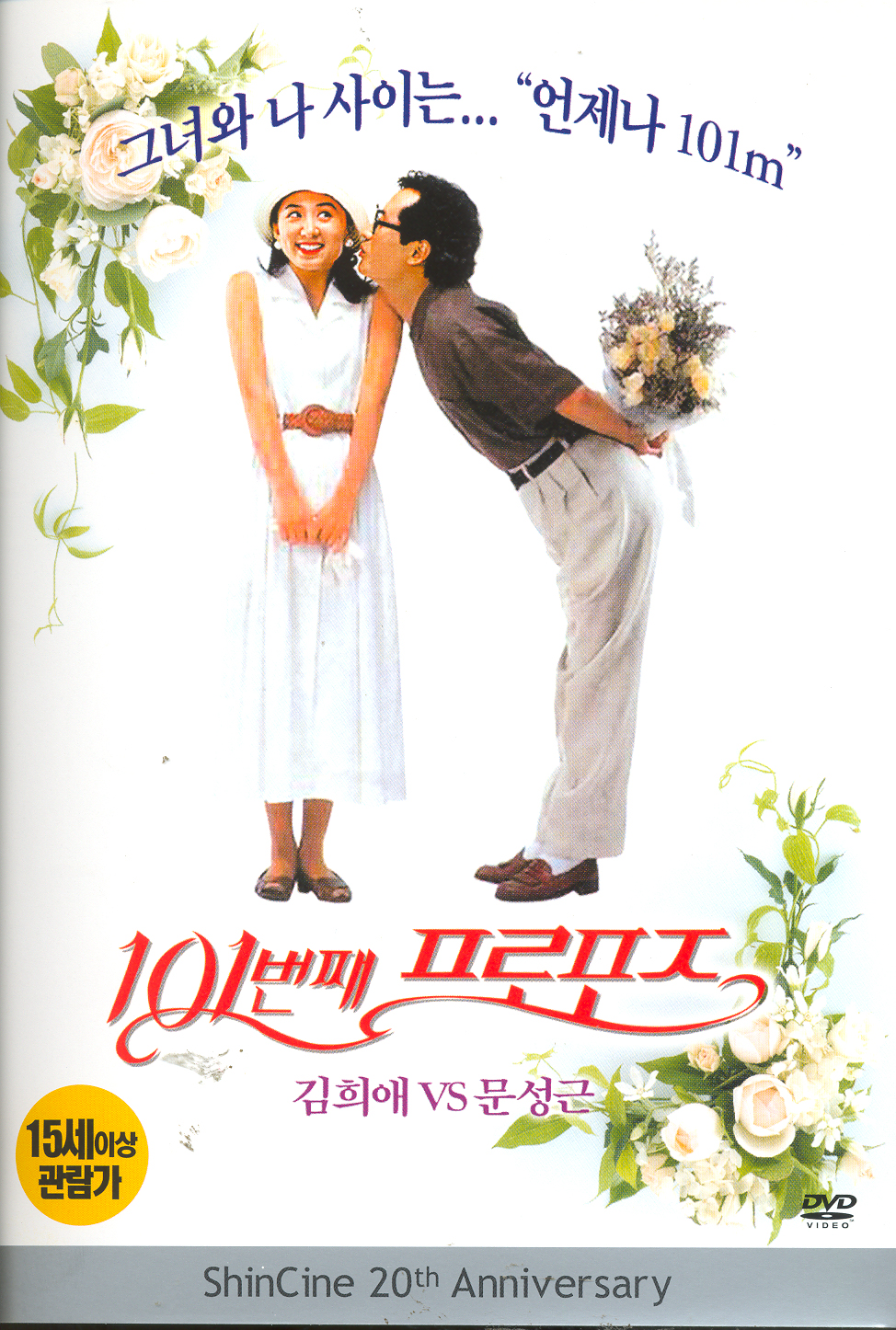
Poster: The 101st Proposal (1993), via KMDb
Ask anyone who saw The 101st Proposal (백한번째 프로포즈) in 1993 what they remember, and you’ll usually get two answers: Moon Sung-keun as the most hopeless suitor in Korean cinema, and the song that plays when his persistence finally pays off. That song is “Say Yes,” sung by Ra Jong-min (라종민).
It’s a strange piece of history when you think about it. In 1993, you couldn’t walk into a Korean record shop and buy a Japanese pop single. Yet that summer, moviegoers across the country left theaters humming a melody written in Tokyo two years earlier. “Say Yes” was how a Japanese mega-hit made it into Korea: not as an import, but as a Korean love song.
Post Highlights
The theme of a 1993 romantic comedy. “Say Yes” plays over the emotional payoff of The 101st Proposal, and for many viewers the film and the song are impossible to separate.
A Japanese classic in Korean form. The melody comes from CHAGE and ASKA’s 1991 “SAY YES,” one of the best-selling singles in Japanese history.
One singer, one song. Ra Jong-min recorded other music, but this is the song his name will always be attached to.
Song Information
| Category | Details |
|---|---|
| Song | Say Yes |
| Artist | Ra Jong-min (라종민) |
| Released | 1993 |
| Album | The 101st Proposal (백한번째 프로포즈) Original Soundtrack |
| Genre | Ballad · Movie OST |
| Featured In | The 101st Proposal (1993), dir. Oh Seok-geun, starring Moon Sung-keun and Kim Hee-ae |
| Original Song | “SAY YES” by CHAGE and ASKA (1991), theme of the Fuji TV drama 101回目のプロポーズ |
About the Film
The premise is wonderfully unglamorous. Gu Young-seop (Moon Sung-keun) is thirty-nine, unmarried, not well off, and falling behind at work. He’s a decent man, but nothing about him looks like a romantic lead. At his hundredth matchmaking meeting, he’s paired with Han Ji-won (Kim Hee-ae), a cellist from a wealthy family who has never gotten over her first love. She is clearly out of his league, and the film knows it. What follows is a long, often embarrassing campaign of devotion.
The film was made by Shin Cine, at the time the restless young upstart among Korean production companies, and it played well with high school and college audiences thanks to its quick dialogue and fresh tone. Not every critic was won over. One newspaper review praised the two leads but complained that some of the conflict felt manufactured. That’s a fair point. Still, the film was never really about its plot. It asks whether sincerity, on its own, can be enough. “Say Yes” is its answer.
From Tokyo to Seoul
Both the story and the song started in Japan. In 1991, Fuji TV aired 101回目のプロポーズ, and its theme song, CHAGE and ASKA’s “SAY YES,” became a phenomenon. It held the No. 1 spot on Oricon’s weekly singles chart for 13 straight weeks and sold about 2.8 million copies, which still ranks it among Japan’s best-selling singles of all time.
The Korean film followed the drama’s outline closely, and it kept the song too, now sung in Korean. This is what makes the case interesting. Japanese popular culture was officially shut out of the Korean market until the gradual opening that began in 1998. So for most Korean listeners in 1993, Ra Jong-min’s “Say Yes” wasn’t “the Korean version” of anything. It was simply the song from the movie. Many people only found out years later where the melody came from.
The Song Itself
What stands out when you listen now is how little the song tries to impress. A soft piano, warm strings, and a vocal that never forces anything. There’s no big key change and no showy climax. It sits close to the story and lets the scene do the work.
The hook is a request rather than a declaration: say yes. That fits a film about a man who has heard “no” more times than he can count. The song doesn’t promise that love will win. It just asks, once more, and hopes.
Recommended Performance
🎥 Ra Jong-min – “Say Yes” KBS Gayo Top 10 (October 13, 1993)
This broadcast performance comes from autumn 1993, a few months after the film’s release, when the song was at its peak. It’s worth watching for the period feel alone: the set, the camera work, and a singer standing still and simply singing.
Curator’s Note
Pre-1998 Korean versions of Japanese songs occupy a gray zone in K-pop history. Some were adapted openly, others quietly, and a few later became plagiarism controversies. “Say Yes” falls on the more transparent side of that history. The film itself was built on a Japanese drama, and the song came with the story.
Listening to it today, I don’t hear a cover so much as a translation in the fullest sense: the same melody carried into a different language, a different city, and a different kind of loneliness.
It took Young-seop a hundred tries. The song needs only one word.