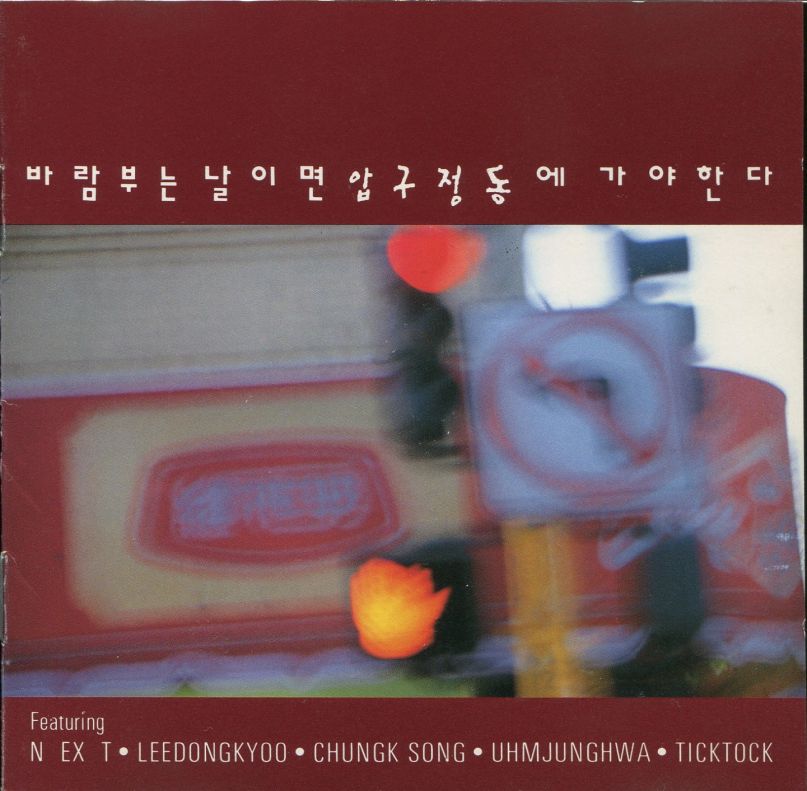
Released in January 1993, Windy Days in Apgujeong (바람부는 날이면 압구정동에 가야 한다) arrived at a moment when Seoul was changing rapidly.
Directed by poet and filmmaker Yoo Ha (유하) and adapted from his poetry collection of the same name, the film turned its attention to Apgujeong, a district that had become closely associated with consumer culture, fashion, wealth, and the aspirations of a new urban generation.
Rather than simply celebrating that world, the film examined the desires and contradictions surrounding it.
Its soundtrack added another layer to the portrait.
Led by Shin Hae-chul (신해철) and featuring musicians associated with N.EX.T, along with Tick Tock and a young Uhm Jung-hwa (엄정화), the album combined rock, electronic textures, programmed sounds, and pop songwriting.
One track would take on particular significance: “Pupil” (눈동자), sung by Uhm Jung-hwa near the beginning of a music career that would soon make her one of the defining Korean pop stars of the 1990s.
Post Highlights
Shin Hae-chul Behind the Soundtrack
Shin Hae-chul served as the soundtrack’s musical director and producer, contributing composition, arrangement, keyboards, synthesizer, sampler, computer programming, backing vocals, and other elements of the production.
Uhm Jung-hwa’s “Pupil”
The soundtrack included “Pupil” (눈동자), written and composed by Shin Hae-chul and performed by Uhm Jung-hwa. The song became an important starting point in her early recording career.
Apgujeong as a Cultural Symbol
The film used Apgujeong as more than a setting. By the early 1990s, the neighborhood had become a highly visible symbol of Seoul’s emerging consumer culture and changing ideas about youth, wealth, fashion, and desire.
Rock, Electronics, and Film Music
Rather than relying on a single musical style, the soundtrack moved between rock, electronic production, pop songs, love themes, and instrumentals, creating a musical portrait of the film’s urban world.
Key Information
| Category | Details |
|---|---|
| Film Title | Windy Days in Apgujeong (바람부는 날이면 압구정동에 가야 한다) |
| Director | Yoo Ha (유하) |
| Film Release | January 22, 1993 |
| Music | Shin Hae-chul (신해철) |
| Featured Performers | N.EX.T, Tick Tock, Uhm Jung-hwa, Lee Dong-kyu |
| Key Track | “Pupil” (눈동자) – Uhm Jung-hwa |
| Sound | Rock · Electronic Pop · Synth-based Production · Ballad |
Apgujeong in the Early 1990s
To understand the soundtrack, it helps to understand what Apgujeong represented at the time.
South Korea was experiencing rapid economic and cultural change, and Apgujeong emerged as one of Seoul’s most recognizable spaces for new forms of consumption and urban aspiration.
Imported cars, fashion, cafés, nightlife, and conspicuous consumption became associated with the neighborhood. The term “orange tribe” (오렌지족) also became part of the popular vocabulary used to describe affluent young people associated with this new lifestyle.
For Yoo Ha, however, Apgujeong was not simply fashionable scenery.
His poetry had already examined consumer capitalism, popular culture, and material desire. In Windy Days in Apgujeong, the neighborhood became a space in which attraction and criticism could coexist: glamorous from the outside, but also filled with anxiety about money, identity, relationships, and success.
The music had to belong to that world.
Shin Hae-chul and the Sound of the Film
By 1993, Shin Hae-chul had already established himself as one of the most distinctive musicians of his generation.
For this soundtrack, he took on a broad creative role as director and producer while also contributing piano, synthesizer, sampler, computer programming, arrangement, backing vocals, and rap.
But the album was not a solo project.
Members and associates of N.EX.T contributed extensively, including Jung Ki-song (정기송) and Lee Dong-kyu (이동규), while other musicians added saxophone, guitar, backing vocals, and production work.
That collaboration gives the soundtrack a wider musical range than a conventional collection of background themes.
Songs such as “Komerican Blues” (코메리칸 블루스) and “When I Open a Blue Vinyl Umbrella” (푸른 비닐우산을 펴면) connect the record directly to N.EX.T’s rock sound, while tracks such as “City Riders” use instrumental music to evoke the urban environment itself.
The result is an album closely tied to its film but capable of functioning independently as a record of early-1990s Korean rock and electronic production.
Uhm Jung-hwa and “Pupil”
The soundtrack is also notable for capturing Uhm Jung-hwa at the beginning of her career.
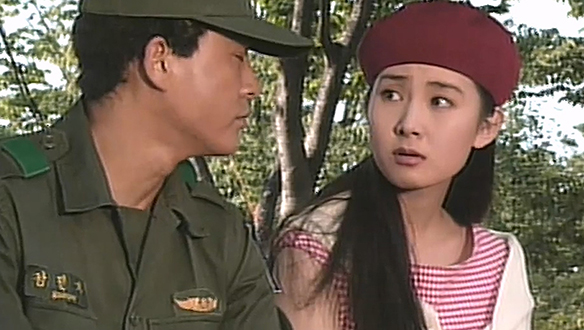
She appeared in the film as Oh Hye-jin (오혜진) and performed “Pupil” (눈동자) for its soundtrack.
Written and composed by Shin Hae-chul, the song is built around a restrained electronic arrangement and Uhm’s low, distinctive vocal tone. Rather than anticipating the high-energy dance music for which she would later become famous, “Pupil” presents a darker and more atmospheric version of her musical identity.
The song was later included on her first album, …Sorrowful Secret.
That makes “Pupil” especially interesting in retrospect.
The Uhm Jung-hwa who would later become closely associated with Korean dance-pop had not yet fully emerged. Here, listeners can hear her before that image and musical identity were firmly established.
🎥 Uhm Jung-hwa – “Pupil” (눈동자) 1993 TV Performance
Tracklist
| No. | Song | Performer / Notes |
|---|---|---|
| 01 | 코메리칸 블루스 (Komerican Blues) | N.EX.T |
| 02 | 설레이는 소년처럼 (Like an Excited Boy) | Tick Tock |
| 03 | 푸른 비닐우산을 펴면 (When I Open a Blue Vinyl Umbrella) | N.EX.T |
| 04 | 눈동자 (Pupil) | Uhm Jung-hwa (엄정화) |
| 05 | 안녕이라 말하고 (Love Theme) | Lee Dong-kyu (이동규) |
| 06 | 후회란 말은 내게 없는 것 (There Is No Such Word as Regret for Me) | N.EX.T |
| 07 | City Riders | N.EX.T · Instrumental |
| 08 | 하나대 Theme (Hanadae Theme) | Jung Ki-song (정기송) · Instrumental |
The original LP and cassette divided tracks 1–4 onto Side A and tracks 5–8 onto Side B.
More Than “Pupil”
Because Uhm Jung-hwa later became such a major figure in Korean pop, it is easy to view this soundtrack primarily as the record that introduced “Pupil.”
But doing so overlooks much of what makes the album interesting.
The soundtrack sits at the intersection of several developments taking place in Korean popular culture at the beginning of the 1990s.
Rock musicians were experimenting more extensively with synthesizers, sampling, MIDI, and computer-based production. Korean cinema was beginning to portray a younger, more urban generation. At the same time, neighborhoods such as Apgujeong were becoming shorthand for the opportunities and contradictions created by rapid economic growth.
Those elements meet on this album.
Its rock tracks, electronic textures, pop vocals, and urban instrumentals do not merely accompany the film. They help preserve something of the atmosphere surrounding Seoul at that particular moment.
Why It Matters
The historical value of the Windy Days in Apgujeong soundtrack comes from more than a single famous song.
It documents Shin Hae-chul’s expanding role as a producer and musical director, shows the sound of N.EX.T-era rock intersecting with film music, and contains an early recording by Uhm Jung-hwa before her emergence as one of the central figures of 1990s Korean pop.
It also belongs to a film that treated Apgujeong as a symbol of a changing Seoul.
Together, the film and soundtrack capture a period when Korean popular culture was negotiating new ideas about consumption, youth, music, image, and modern urban life.
Curator’s Insight
Today, “Pupil” (눈동자) is often heard with the benefit of hindsight.
We already know what happened next.
Uhm Jung-hwa became one of the defining female pop performers of her generation. Shin Hae-chul continued to expand the possibilities of Korean rock and electronic production. And the polished, image-conscious urban culture represented by early-1990s Apgujeong became an increasingly familiar part of Korean popular media.
But in 1993, none of that history had fully taken shape.
That is what makes this soundtrack worth returning to.
It preserves a moment before those trajectories became obvious: an emerging singer, an experimental producer, a rapidly changing neighborhood, and a Korean pop culture that was still discovering what the 1990s would sound like.