Introduction: I Didn’t Learn K-pop History—I Grew Up With It
There are plenty of websites that explain K-pop through debut dates, album sales, and entertainment companies. Those facts are useful, but they only tell part of the story.
K-pop isn’t just an industry. It’s a culture that has constantly reinvented itself—and for many Koreans, it’s also part of our childhood.
I grew up in Seoul during the mid-1990s, right as the first generation of idol groups was taking shape. Long before YouTube, Spotify, or social media, I watched fans line up outside television stations, memorized comeback schedules from magazines, and saw entire crowds waving balloons in a single group’s official color.
Years later, after moving to Canada, I experienced something I never imagined as a child: friends who didn’t speak Korean were suddenly asking me about BTS, BLACKPINK, and NewJeans. Watching K-pop evolve from a local youth culture into a global phenomenon has been fascinating because I experienced both worlds.
To understand today’s K-pop, it helps to understand how we got here. Fans often divide K-pop into different “generations,” with each era shaped by changes in music, technology, fan culture, and the industry’s global ambitions.
Let’s take a journey through the five generations of K-pop.
What Defines a K-pop Generation?
Unlike official historical periods, K-pop generations don’t have fixed legal boundaries. They’re generally recognized when the industry experiences major shifts in four areas:
- Industry System – How entertainment companies recruit, train, and promote artists.
- Media & Technology – The move from television and CDs to YouTube, streaming platforms, and social media.
- Target Market – The expansion from domestic audiences to Asia, and eventually to simultaneous worldwide releases.
- Fandom Culture – The evolution from fan-club hotlines and colored balloons to global fan communities connected through apps and livestreams.
The Five Generations of K-pop at a Glance
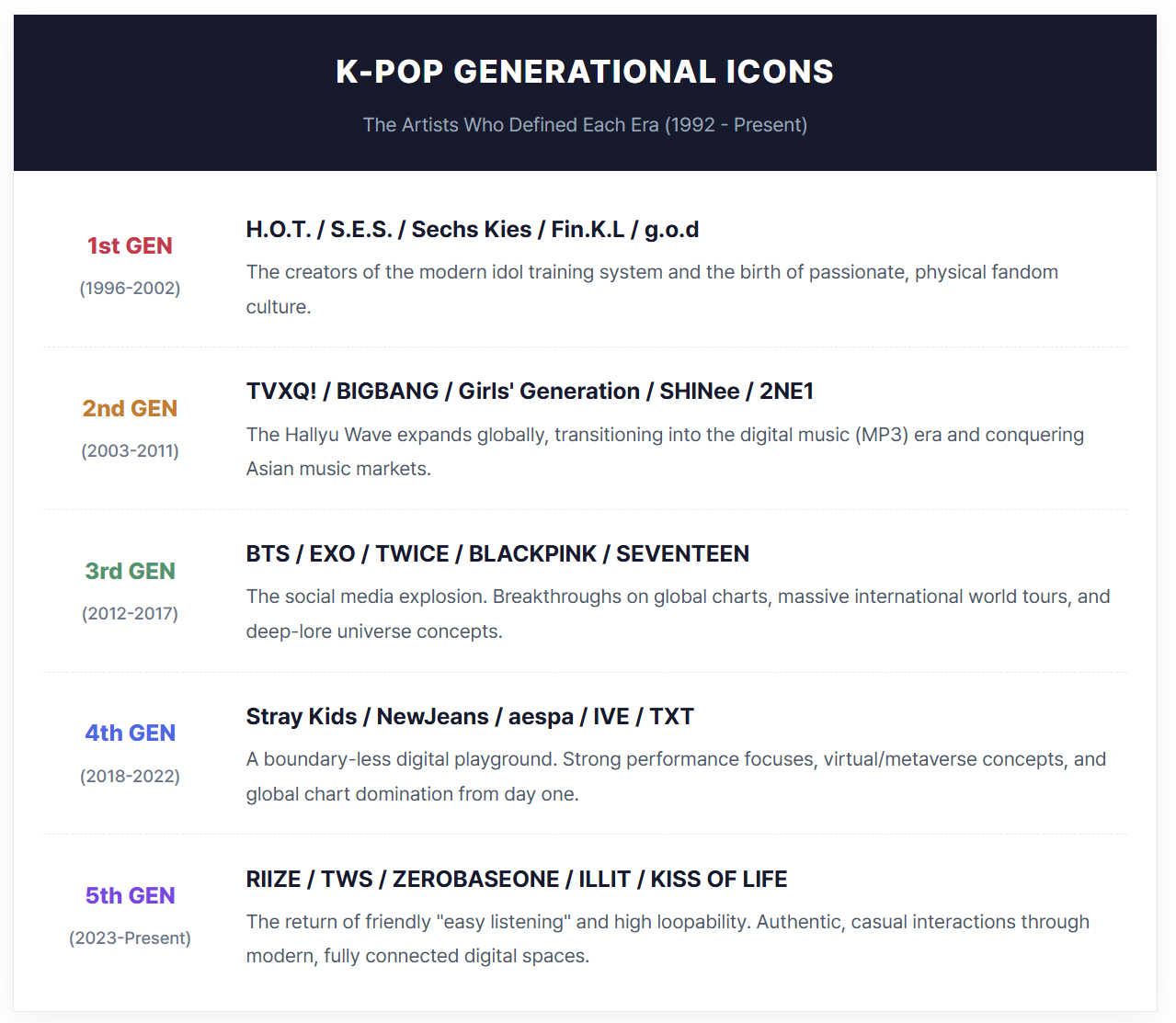
1st Generation (1996–2002): Where Everything Began
Representative Artists: H.O.T., Sechs Kies, S.E.S., Fin.K.L, god, Shinhwa
The modern idol system was born during this period. Entertainment agencies began developing young trainees through structured programs, creating the blueprint that many companies still follow today.
What I remember most wasn’t just the music—it was the fandom. Fans proudly carried balloons in their group’s official color, gathered at Dream Concert, and debated music show rankings long before online fandom existed.
Back then, we didn’t have smartphones or social media. If you wanted to know your favorite idol’s schedule, you often relied on magazines, television, or recorded messages through fan hotlines. Looking back now, it feels almost impossible to imagine.
2nd Generation (2003–2011): K-pop Crosses Borders
One of the most viral and era-defining hook songs of the 2nd Generation.
Representative Artists: TVXQ!, BIGBANG, Super Junior, Girls’ Generation, Wonder Girls, SHINee, 2NE1, KARA
As digital music replaced CDs, entertainment companies began looking beyond Korea. Japan, China, and Southeast Asia became major markets, and K-pop slowly built an international fan base.
This was also the era of unforgettable hook songs. Tracks like Gee and Sorry, Sorry spread rapidly through the early days of YouTube, introducing countless international listeners to Korean pop music.
Thinking back, it felt like K-pop suddenly became impossible to avoid. You heard these songs in shopping malls, school festivals, and cafés—they became part of everyday life.
3rd Generation (2012–2017): The World Discovers K-pop
Representative Artists: BTS, EXO, SEVENTEEN, BLACKPINK, TWICE, Red Velvet, NCT
Social media completely changed the industry’s trajectory.
Platforms like Twitter, YouTube, Instagram, and V Live allowed international fans to follow artists without waiting for television broadcasts or overseas promotions. At the same time, physical album sales made an unexpected comeback as collectors embraced elaborate packaging and photocards.
By this point I was living overseas, and I noticed something remarkable. People who had never shown interest in Korean culture suddenly knew BTS songs or recognized BLACKPINK members. K-pop was no longer something I had to explain—it had become part of global pop culture.
4th Generation (2018–2022): Born Global
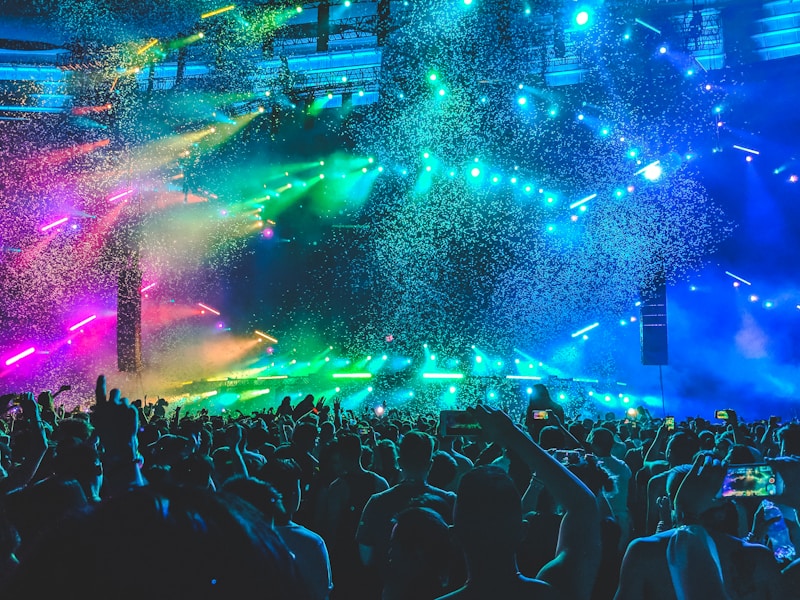
The 4th Generation defined itself with hyper-focused digital concepts, distinct sub-genres, and immediate global reach.
Representative Artists: Stray Kids, TOMORROW X TOGETHER, NewJeans, IVE, aespa, LE SSERAFIM, ENHYPEN
Many fourth-generation groups debuted around the pandemic, yet they expanded internationally faster than any previous generation.
High-performance choreography, cinematic storytelling, virtual concepts such as aespa’s AI avatars, and immediate success on Billboard charts became defining characteristics. Girl groups also dominated digital charts with confident, trend-setting concepts that resonated worldwide.
Unlike earlier generations that gradually expanded overseas, these artists debuted with a global audience already in mind.
5th Generation (2023–Present): Simplicity Makes a Comeback
Representative Artists: RIIZE, TWS, ZEROBASEONE, ILLIT, BABYMONSTER, KISS OF LIFE
After years of increasingly complex concepts, many newer groups have embraced a lighter, more approachable style.
Easy-listening songs, nostalgic influences from late-1990s and early-2000s pop and R&B, and shorter, highly replayable tracks fit naturally into today’s streaming and short-form video culture.
Fan interactions have also become more casual. Rather than maintaining distance, idols now communicate almost daily through livestreams, messaging platforms, and social media, creating relationships that feel far more personal than those of earlier generations.
Looking Ahead
Every generation built on the one before it.
But if there’s one moment that truly changed everything, it happened before H.O.T. ever debuted.
In our next article, we’ll travel back to 1992 and explore the story of Seo Taiji and Boys—the group that transformed Korean popular music and laid the foundation for everything we now call K-pop.
Which generation first made you a K-pop fan? I’d love to hear your story in the comments.