Why the Group’s “Dynamite” Performance Marked Another Milestone for K-pop
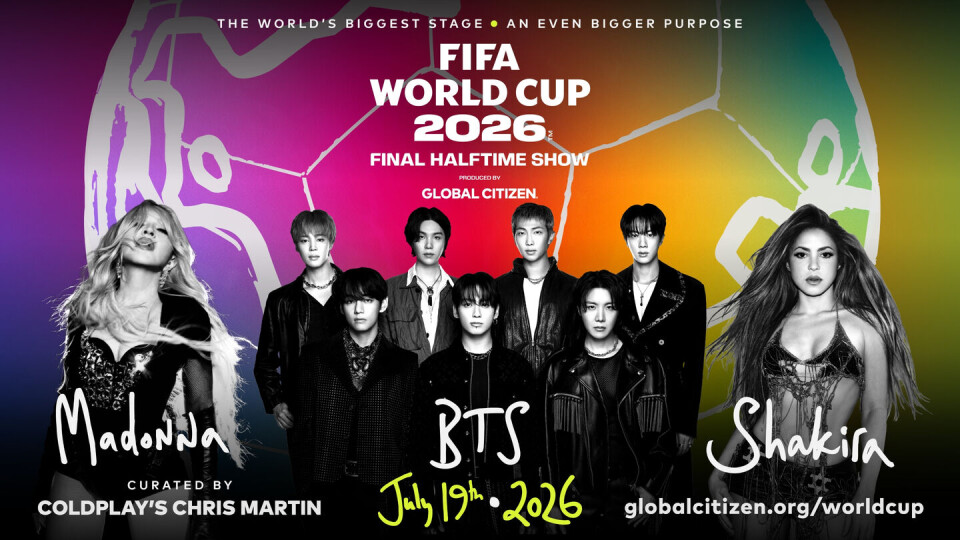
On July 19, 2026, BTS performed at the first official halftime show ever staged during a FIFA World Cup final.
The group appeared during the championship match between Spain and Argentina at New York New Jersey Stadium, joining co-headliners Madonna, Shakira, and Justin Bieber in a historic new production curated by Coldplay’s Chris Martin.
For BTS, the performance was another major international appearance.
For K-pop, however, it represented something larger. A Korean group was no longer being presented as a guest from a specialized regional music scene. BTS stood as one of the central performers at a new global entertainment event created around the world’s biggest football match.
The World Cup’s First Official Halftime Show
Music has long been part of the FIFA World Cup.
Official songs, opening ceremonies, closing ceremonies, and live performances have helped define tournaments for decades. Artists such as Shakira and Ricky Martin became closely associated with previous World Cups.
The 2026 final introduced something different.
For the first time, FIFA placed a large-scale musical production inside the halftime interval of the final itself. The approximately 11-minute show brought a Super Bowl-style entertainment format to the World Cup’s championship match.
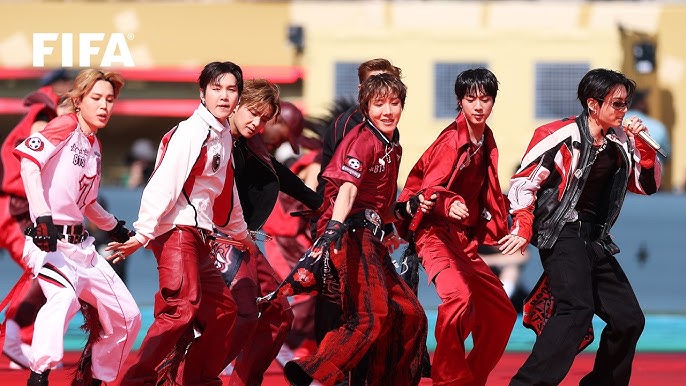
Madonna opened the show with “Music.” The performance also included conductor Gustavo Dudamel and the Muppets’ Electric Mayhem, followed by BTS performing “Dynamite.” Justin Bieber appeared with an acoustic performance, while Shakira and Burna Boy performed “Dai Dai,” the official song of the 2026 tournament.
The halftime program was also connected to the FIFA Global Citizen Education Fund, an initiative designed to expand access to education and football opportunities for children.
Why BTS Performed “Dynamite”
▶️ Watch BTS’s Full Stage on FIFA Official YouTube
BTS could have selected from many songs representing different stages of its career.
Instead, the group performed “Dynamite,” the bright English-language single that became one of its most recognizable international hits.
The choice suited an event designed for a massive global audience. Its disco-pop sound, energetic choreography, and celebratory mood could communicate immediately, even to viewers who did not closely follow K-pop.
The song also carried historical meaning.
Released in 2020, “Dynamite” played an important role in BTS’s transition from the world’s most prominent K-pop group into a major force within the broader global pop market. At the World Cup final, it served as an immediate symbol of the group’s international breakthrough.
The performance was brief, but that brevity was part of the format. BTS was one act within a tightly compressed global medley.
Its significance came not from the length of the set, but from where the group was placed and how it was presented.
BTS did not appear in a separate K-pop segment.
It appeared as one of the show’s principal global acts.
From Korean Idol Group to Global Pop Institution
When BTS first began attracting international attention, Western media often explained the group primarily through the category of K-pop.
That description was accurate, but it gradually became incomplete.
Over the following years, BTS topped major album and singles charts, performed at international award shows, addressed the United Nations, toured stadiums, and built one of the largest fan communities in contemporary music.
The World Cup halftime show reflected the result of that expansion.
BTS was selected not simply because FIFA wanted Korean representation, but because the group had become recognizable enough to stand beside established international stars in a broadcast intended for viewers across continents.
This is an important distinction.
Earlier Korean performers often appeared at international events as cultural representatives of South Korea. BTS increasingly appears as part of the global pop establishment itself.
The group remains unmistakably Korean, but its international presence no longer requires explanation through nationality alone.
A New Moment in K-pop History
K-pop’s international growth did not begin with BTS.
Korean artists had been building overseas audiences for decades. First-generation idol groups expanded into markets across East Asia. BoA established a major career in Japan. TVXQ, Super Junior, Girls’ Generation, BIGBANG, and other acts helped widen K-pop’s international reach. PSY’s “Gangnam Style” then became a worldwide phenomenon in 2012.
BTS pushed that development into another phase.
Rather than being defined by one breakthrough song or one overseas market, the group achieved sustained international success across albums, singles, touring, streaming, and global media.
BTS’s World Cup performance therefore belongs within a much longer history:
- Korean pop expanded across Asia through the growth of early idol groups and overseas promotions.
- K-pop became increasingly visible worldwide through online video, social media, and global fan communities.
- Artists such as PSY and BTS entered mainstream international charts and media on an unprecedented scale.
- BTS became one of the co-headliners chosen to inaugurate the FIFA World Cup Final Halftime Show.
That final step matters because the FIFA World Cup is not a Korean music event, a K-pop festival, or a traditional music awards ceremony.
It is a global sporting institution.
BTS’s inclusion demonstrated how far Korean popular music had traveled from being perceived as a regional phenomenon.
Not a Solo BTS Concert—and That Was the Point
The performance should not be exaggerated.
BTS did not headline the entire event alone, nor did the group perform an extended concert set. It shared the roughly 11-minute program with several other international performers.
But treating that as a limitation misses the historical point.
The importance of the appearance was precisely that BTS belonged within the lineup without requiring a separate explanation or a special K-pop category.
The group was presented as one of several artists capable of representing contemporary global popular culture at a newly created World Cup spectacle.
For many years, discussions of K-pop’s international success focused on whether Korean musicians could enter the mainstream.
By 2026, that question had changed.
The issue was no longer whether BTS could be invited onto the world stage. The group was already helping define what that stage looked like.
More Than a Performance
The first FIFA World Cup Final Halftime Show was also part of a broader transformation in international sports.
Major sporting events increasingly operate as global entertainment platforms, combining competition, music, celebrity, sponsorship, and social campaigns in a single broadcast.
The extended interval was not universally welcomed. Because the performance required additional time to install and remove staging equipment, the halftime break ran longer than the traditional 15-minute interval, raising questions about whether a Super Bowl-style production belonged inside a football match.
Whether FIFA continues this format in future tournaments remains to be seen.
Still, its first edition will remain historically significant.
And BTS was part of that beginning.
Why the Moment Matters
BTS’s performance at the 2026 FIFA World Cup final was not important simply because a Korean group appeared on a famous stage.
It mattered because the appearance reflected a deeper cultural change.
K-pop had moved from the margins of the international music industry into the center of global entertainment. A group that began within South Korea’s idol system was now standing alongside Madonna, Shakira, and Justin Bieber at the launch of a new World Cup tradition.
For BTS, “Dynamite” lasted only a few minutes.
For the history of K-pop, the image may last much longer.
Frequently Asked Questions
Q: Did BTS headline the 2026 FIFA World Cup Final Halftime Show?
A: BTS was one of the event’s four principal co-headliners, alongside Madonna, Shakira, and Justin Bieber.
Q: Which song did BTS perform?
A: BTS performed “Dynamite,” one of the group’s best-known international hits.
Q: Was this the first halftime show in FIFA World Cup Final history?
A: Yes. FIFA presented the 2026 production as the first official musical halftime show held during a World Cup final.
Q: Why was the performance historically significant?
A: The appearance placed BTS among the principal performers at the launch of a new global World Cup entertainment format. It also reflected K-pop’s evolution from a primarily regional music industry into an established part of mainstream international popular culture.